
Key Takeaways:
AI search optimization for industrial B2B has quietly become the difference between winning a buyer’s attention and never entering the conversation at all. Somewhere right now, a procurement manager is typing a question into ChatGPT instead of Google: “Who makes 6061 aluminum extrusions in the Southeast?” “Which steel service centers handle automotive-grade blanking?” “Which portable classroom supplier is approved for E&I co-op purchasing?“
If a website can’t answer that question clearly, the AI tool skips it and moves to a competitor who can. The product quality doesn’t matter yet. Visibility does. That’s ChatGPT visibility for B2B in practice: either a business shows up in the answer, or it doesn’t exist for that buyer.
This shift is bigger than most industrial marketing teams realize. A recent multi-source analysis found that 73% of B2B buyers now use AI tools like ChatGPT and Perplexity somewhere in their research process (PRNewswire, 2026). Google’s own AI Overviews now reach more than 2.5 billion monthly users across 200+ countries, according to CEO Sundar Pichai’s May 2026 update (CNBC). The buying journey didn’t move to a new website. It moved to a new kind of search engine, one that reads a page, decides whether to trust it, and either quotes it or ignores it completely.
That’s exactly what AI search optimization for industrial B2B solves.
What is AI search optimization for industrial B2B?
AI search optimization, sometimes shortened to “AI SEO,” covers two related disciplines: answer engine optimization (AEO) and generative engine optimization (GEO). Both aim for the same outcome: getting a business cited by AI instead of just crawled by it.
Answer Engine Optimization (AEO) targets the short, direct answer. When a buyer asks a quick factual question, AEO makes sure an AI tool can lift a clean answer straight from a page. Think of it as the AI-era version of a featured snippet.
Generative Engine Optimization (GEO) targets the deeper question. When a buyer asks something more complex (capabilities, certifications, process details), GEO ensures the AI system treats a site as a detailed, trustworthy source worth quoting at length.
Manufacturers need both. A buyer might ask a quick question first (“Do they offer custom finishes?”) and follow it immediately with a detailed one (“Walk me through their quality control process for aerospace-grade parts”). A site built for only one type of question stays half-visible. That’s the practical shape of AI search for manufacturers today: two disciplines working together, not one replacing the other.
Why industrial B2B buyers search differently
Most AI-search advice online targets SaaS companies and content marketers. It doesn’t reflect how industrial buying committees actually use AI during procurement research.
Industrial buyers ask procurement-driven questions. They want capacity numbers, tolerances, certifications, lead times, and service areas. That happens to be exactly the kind of query AI answer engines handle best, but only when the source material gives the model something concrete to work with.
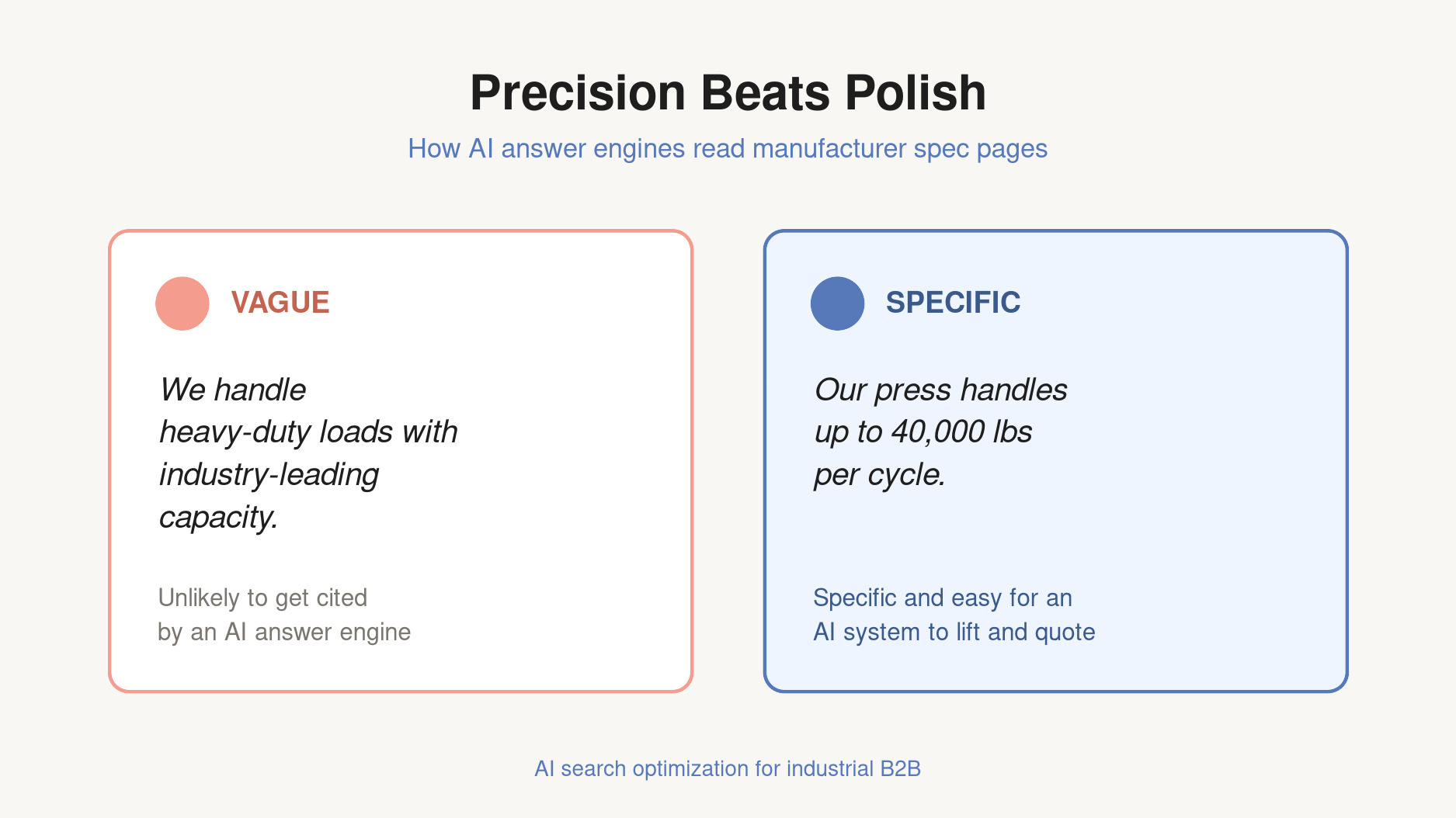
A vague “About Us” paragraph never gets quoted. A page that states specs as numbers instead of adjectives does. Compare these two lines:
- “We handle heavy-duty loads with industry-leading capacity.” (vague, unlikely to get cited)
- “Our press handles up to 40,000 lbs per cycle.” (specific, easy for an AI system to lift and quote)
Precision beats polish here. A keyword with ten searches a month can carry more closed revenue than one with a thousand searches, if those ten searches come from qualified buyers typing a certification-specific question into an AI tool. Search volume tells only part of the story anymore.
The local piece: AI search and your Google Business Profile
AI search optimization isn’t only a website problem. It’s a local visibility problem too, and that matters whether a business serves a single metro area or the whole country.
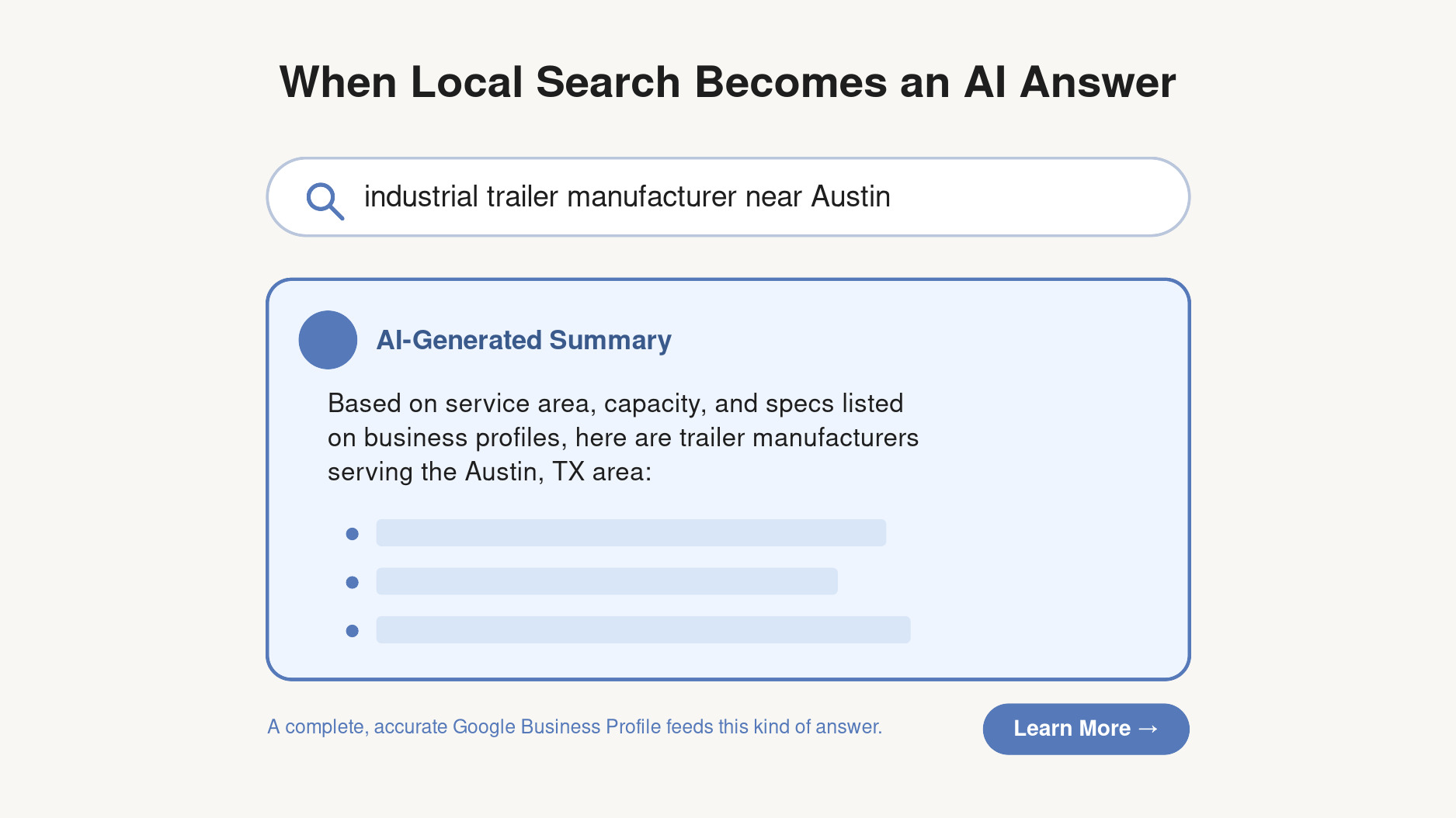
Businesses based in Austin, Texas, and similar hubs increasingly compete for both local and national attention at the same time. A local trailer fabricator might get discovered by a nearby buyer through a Google Business Profile search, while a national steel distributor gets cited by an AI tool answering a completely different buyer three states away. The same fundamentals support both outcomes: a complete, accurate Google Business Profile, consistent business information across the web, and service pages detailed enough for an AI system to understand exactly what a company does and where it operates.
Real-world scenario: a facilities manager searches “industrial trailer manufacturer near Austin” and gets an AI-generated summary instead of a list of blue links. That summary pulls from whichever business has the clearest, most complete information available, not necessarily the business with the best product. Keeping a Google Business Profile current, with accurate hours, service areas, and photos, directly feeds this new kind of local AI visibility.
What actually moves the needle
Three changes carry the most weight, in order of impact.
1. Structure content so AI can quote it
Use question-shaped headings that match how buyers actually ask. Answer the question directly in the first sentence or two, then add supporting detail below. State specifications as numbers, not adjectives.
2. Add structured data (schema markup)
Schema markup tells an AI system exactly what it’s looking at instead of making it guess. Organization schema, Product schema, and structured data for B2B websites all help AI understand services accurately. One important update: Google removed FAQ rich results from standard Search as of May 2026 (Search Engine Journal), so FAQ schema no longer produces the classic search snippet it once did. It still helps AI answer engines parse and understand a page’s content, which is why an FAQ section remains worth including, just not for the reason most sites used it a few years ago.
3. Build topical depth, not just volume
Case studies, detailed service pages, and internally linked content show an AI system that a business is a real, connected source of expertise, not one orphaned page trying to rank for everything. Depth beats breadth in AI search.
None of this replaces traditional SEO. It’s what SEO becomes when the audience reading a site is sometimes a person and sometimes a model deciding whether to recommend that business to one.
Common questions about AI search optimization
No. AI Overviews for industrial companies of every size are becoming common, and local and regional businesses benefit just as much, especially through Google Business Profile optimization and clear service-area content that AI tools can reference for location-based questions.
Timelines vary. Most businesses see AI systems pick up restructured, well-marked-up content faster than they’d see traditional keyword rankings shift, often within a few weeks of publishing clearer, more specific content. Reach out and we’ll walk through a realistic timeline.
No. They work together. A well-optimized traditional SEO foundation makes AI search optimization easier to layer on top, since both rely on clear, well-organized, technically sound content.
Search changed. Most marketing plans haven't caught up yet.
Dremana Productions has spent nearly 30 years building websites, content, and search strategy for B2B and B2C brands, from Austin-based businesses to national industrial manufacturers. AI search optimization for industrial B2B is the next chapter of that same work: making sure the right buyer finds a business, whether they're searching on Google, asking ChatGPT, or scrolling through Google Business Profile results.
Book a free 30-minute Strategy Session and find out exactly where a site stands today, and what it takes to get cited, not just crawled.
Search your business name and key services directly in ChatGPT, Perplexity, and Google AI Overviews to see what comes back. Referral traffic from these tools also shows up in most analytics platforms as its own source, separate from organic search, once you know where to look.
It builds on regular SEO rather than replacing it. Traditional SEO still matters for crawlability, site speed, and keyword relevance. AI search optimization adds a layer on top: structuring content so a model can extract a clean, accurate answer from it.

Ready to get found by AI,
not just Google?
Search changed. Most marketing plans haven’t caught up yet.
Dremana Productions has spent nearly 30 years building websites, content, and search strategy
for B2B and B2C brands, from Austin-based businesses to national industrial manufacturers. AI
search optimization for industrial B2B is the next chapter of that same work: making sure the
right buyer finds a business, whether they’re searching on Google, asking ChatGPT, or scrolling
through Google Business Profile results.
Book a free 30-minute Strategy Session and find out exactly where a site stands today, and
what it takes to get cited, not just crawled.
We Collaborate with You. Effective collaboration is born of trust and respect, and it requires both common goals as well as confidence as individuals. When we work with other businesses we use our collaborative skills—innovative idea building, comprehensive planning, clear communication, and creative risk-taking—to help build their brand and business. Dremana’s mission is to show the world how great you really are, not just your brand identity, but who you are as a company. We are a collaborative company, and we want to collaborate with you!
A boutique digital marketing firm nestled in the heart of Austin, Dremana Productions offers web development, SEO Marketing, podcast or video production, company blogs and newsletters, social media posting, and graphic design/infographics. Let us work with you to establish the common goal or your success today! Contact us via our website, or call us at 877-753-1170.